Milburn Stone net worth remains a fascinating example of how classic television stars built lasting wealth through consistency and smart decisions. Best known for his iconic role as Doc Adams on Gunsmoke, Stone turned a long-running TV career into a reliable financial foundation.
Milburn Stone earnings came not only from his Gunsmoke salary but also from syndication income and carefully chosen investments, making his financial journey both inspiring and practical.
From humble beginnings in Kansas to becoming a household name, Milburn Stone success story reflects the power of patience and strategic planning. Milburn Stone wealth didn’t come overnight; it was built over decades through steady work, television residuals, and real estate investments. Even today, Milburn Stone legacy continues through Gunsmoke reruns, proving that classic TV actors could achieve long-term financial stability with the right approach.
Bio / Wiki
| Full Name | Milburn Stone (Hugh Milburn Stone) |
| Born | July 5, 1904, Burrton, Kansas, USA |
| Died | June 12, 1980, La Jolla, California (Heart Attack) |
| Age at Death | 75 Years Old |
| Famous Role | Dr. Galen “Doc” Adams Guns moke (CBS, 1955–1975) |
| Episodes | 605 Episodes over 20 Seasons |
| Emmy Award | 1968 Outstanding Supporting Actor in a Drama |
| Net Worth at Death | ~$600,000 (≈ $2.1 Million in 2026 Dollars) |
| Primary Income | Gunsmoke Salary, CBS Residual Sale, Film Roles, Real Estate |
| Nationality | American |
Who Was Milburn Stone?
Milburn Stone, born Hugh Milburn Stone on July 5, 1904, in Burrton, Kansas, was an American character actor best remembered as Dr. Galen “Doc” Adams, the crusty but compassionate frontier physician on CBS’s landmark Western series Gunsmoke. He was one of only two original cast members, alongside James Arness, to remain on the show for its entire 20-season run from 1955 to 1975.
Milburn Stone was the nephew of Broadway comedian Fred Stone, which may have planted early seeds of theatrical ambition. He left home as a teenager to join traveling repertory troupes, spent years in vaudeville as part of a song-and-dance act called “Stone and Strain,” and eventually made his way to Hollywood in 1935. His career covered over four decades and more than 168 film appearances before Gunsmoke transformed him into a household name.
Milburn Stone died on June 12, 1980, in La Jolla, California, of a heart attack at age 75, five years after Gunsmoke’s final episode and nine years after open-heart surgery in 1971.
Early Life and Education
Milburn Stone grew up during a period of limited opportunity in small-town Kansas. Milburn Stone father, Herbert Stone, worked as a produce wholesaler, providing a modest but grounded upbringing. The Great Depression would later shape Stone’s deep financial conservatism, a trait that distinguished him from many Hollywood contemporaries who spent as fast as they earned.
At Burrton High School, Milburn Stone threw himself into the drama club, sang in a barbershop quartet, and played basketball. These weren’t casual hobbies; they were the beginning of a lifelong commitment to performance.
After graduation, rather than pursuing a conventional path, Milburn Stone left to find work with touring theater companies, training the old-fashioned way: on actual stages, night after night, in front of real audiences.
Milburn Stone time in vaudeville with “Stone and Strain” sharpened his timing, character instinct, and ability to connect with audiences, skills that would define Doc Adams decades later. A minor Broadway appearance in “The Jayhawkers” preceded his 1935 move to Los Angeles, where he spent years in unbilled and supporting roles in films before television arrived to change everything.
Acting Journey and Career Highlights
Milburn Stone path to Gunsmoke was anything but a straight line. After arriving in Hollywood in 1935, he spent years working for Monogram Pictures, a “poverty row” studio known for low-budget serials and B-movies. He appeared in dozens of films without screen credit, playing everything from reporters to robbers, detectives to drifters.
Occasionally, Milburn Stone nabbed a lead role in the crime drama Federal Bullets (1937) and the serial thriller The Great Alaskan Mystery (1944), among others, before returning to supporting status in his very next film. This pattern of reliable but unglamorous work defined Stone’s early career. Milburn Stone also sang for a period with Harry James and His Orchestra, showing the breadth of his entertainment background.
Notable film appearances before Gunsmoke include:
• Young Mr. Lincoln (1939) as Stephen A. Douglas, directed by John Ford
• The Big Sky (1952) supporting role in Howard Hawks’s mountain man epic
• The Tin Star (1957) Western starring Henry Fonda and Anthony Perkins
• 168+ total film credits across four decades
These years of relentless work built the craft that made Doc Adams so believable. Stone was known on the Gunsmoke set for insisting on authenticity, a reputation earned through decades of taking his work seriously, even when the projects didn’t deserve it.
Rise to Fame as “Doc Adams” on Gunsmoke
When CBS launched Gunsmoke on September 10, 1955, nobody anticipated it would run for 20 years and 635 episodes, becoming the longest-running primetime live-action drama in American television history (a record later tied by Law & Order: SVU). Stone was cast as Doc Adams from day one, stepping into a role that would define his career and secure his financial future.
Doc Adams was not the typical TV doctor. Stone played him as gruff, sardonic, perpetually underpaid, and deeply human, a man who delivered babies and patched up gunshot wounds in a lawless frontier town, charging two dollars for house calls and complaining about it the whole time. Audiences loved him instantly.
Milburn Stone on-screen chemistry with James Arness (Marshal Matt Dillon) was central to the show’s emotional core. The two actors developed a genuine friendship off-camera that lasted until Stone’s death. Amanda Blake (Miss Kitty), Dennis Weaver (Chester), and later Ken Curtis (Festus) and Burt Reynolds (Quint) rounded out the ensemble that made Gunsmoke appointment television for two decades.
The show was ranked #27 on TV Guide’s list of the 60 Best Series in 2013, and remarkably, Gunsmoke appeared among Nielsen’s top streaming series as recently as 2025, 70 years after its premiere. Stone’s performance remains central to why the show endures.
Awards, Achievements, and Career Impact
Milburn Stone received his industry’s highest recognition when he won the Primetime Emmy Award in 1968 for Outstanding Performance by an Actor in a Supporting Role in a Drama, after 13 years of playing Doc Adams. The win was widely regarded as long overdue.
Key career achievements include:
• Emmy Award (1968) Outstanding Supporting Actor in a Drama (Gunsmoke)
• Golden Globe Nomination (1971) Best Supporting TV Actor
• Honorary Doctorate, St. Mary of the Plains College, Dodge City, Kansas (upon retirement)
• Hollywood Walk of Fame Star 1975
• Posthumous Hall of Fame Induction, National Museum of Cowboys and Western Heritage, Oklahoma City (1981)
Beyond the hardware, Stone’s lasting impact was on how Western television portrayed supporting characters. Doc Adams demonstrated that secondary roles could carry as much dramatic weight as the lead and that a character actor, not just a leading man, could become genuinely beloved by millions of viewers.
Income Sources Beyond Acting
Milburn Stone net worth was built across several income streams, not just his Gunsmoke salary. Understanding each one gives a clearer picture of how he accumulated and preserved his wealth.
| Income Source | Estimated Amount | Notes |
| Gunsmoke Salary (20 seasons) | ~$500,000 total | Increased from ~$300/week early to $25k/episode late seasons |
| CBS Residual Rights Sale (1961) | $100,000 lump sum | Equivalent to ~$1M today; sold alongside Amanda Blake |
| Film Appearances (168 films) | ~$100,000 total | B-movies + supporting roles across 4 decades |
| Real Estate Investments | Estimated equity | Southern California property during the boom years |
| SAG Pension & Benefits | Ongoing | Screen Actors Guild benefits through retirement |
| Vaudeville & Stage (1920s–30s) | Modest income | Early career foundation before Hollywood |
CBS Residual Rights Sale (1961)
One of the most documented and financially significant moves in Milburn Stone career came in 1961, when he sold all his residual rights to Gunsmoke back to CBS for $100,000. According to IMDb and multiple archived sources, no specific reason was given for this decision. Amanda Blake made an identical deal in the same year for the same amount.
The most likely explanation: both actors wanted immediate capital, possibly for personal investments or expenses, rather than waiting for uncertain future rerun payments. At the time, $100,000 was a substantial lump sum equivalent to roughly $1,030,000 in 2026 dollars.
Whether it was a smart move depends on hindsight: Gunsmoke went on to generate enormous syndication revenue for decades. Still, it gave Stone immediate liquidity he could deploy.
Film Work
Milburn Stone appeared in over 168 films throughout his career, though the cumulative earnings from these were relatively modest compared to Gunsmoke. Most were B-movies or supporting roles. One source estimates total film earnings at approximately $100,000 across his entire pre-Gunsmoke film career, a reflection of how poorly character actors were compensated in that era.
Real Estate
Like many actors of the Hollywood Golden Age, Stone invested in Southern California real estate, a strategy that proved highly effective given California’s property appreciation from the 1950s through the 1970s. The specifics of his real estate portfolio are not publicly documented, but it is noted across multiple sources as a component of his wealth-building strategy.
Real Estate, Assets, and Lifestyle
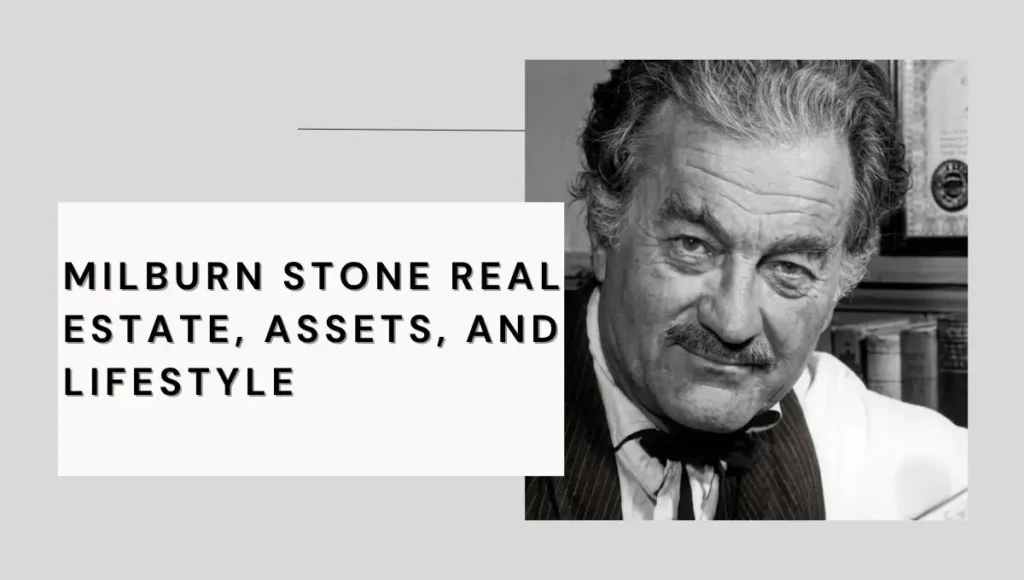
Milburn Stone was not a lavish spender. By most accounts, he lived comfortably but quietly, a disposition shaped by growing up during the Depression and spending years in Hollywood without stardom. He avoided the conspicuous consumption that depleted the fortunes of many of his contemporaries.
At the end of Gunsmoke’s run, Stone retired to a ranch, a fitting conclusion for a man who spent 20 years in a fictional frontier town. His personal life was deliberately kept private; he was not a tabloid figure, which also meant fewer of the costly controversies and divorces that financially devastated other Golden Age actors.
Key lifestyle and asset notes:
• Owned real estate in Southern California, timing aligned with significant appreciation periods
• Retired to a ranch following Gunsmoke’s 1975 cancellation
• Collected antique guns and Western memorabilia
• Maintained close personal friendships with co-stars James Arness and Ken Curtis
• Avoided public controversy throughout his career
• Was friends with Ronald Reagan, then a fellow actor, before his political career
Stone’s brother, Joe Stone, was a writer who authored scripts for three episodes of Gunsmoke, a family connection to the show that underscored how central it was to his world.
Net Worth at the Time of Death vs. Today’s Value
There is a genuine discrepancy across sources regarding Milburn Stone’s net worth at death. The most widely cited figure from Celebrity Net Worth and Famous People Today is $600,000 in 1980 dollars. Some other sources cite $2 million, which appears to be an uncorrected inflation-adjusted figure that was misreported as the nominal value.
The most accurate and sourced figure is $600,000 at the time of his death in 1980, as reported by Celebrity Net Worth, a figure that aligns with the estate valuation cited by multiple independent researchers.
| Year | Net Worth (Nominal) | Equivalent in 2026 USD | Notes |
| 1955 | ~$50,000 | ~$575,000 | Gunsmoke debut, modest salary |
| 1961 | +$100,000 lump sum | ~$1,030,000 | Sold CBS residual rights |
| 1968 | Growing | — | Emmy win; salary leverage increased |
| 1975 | Peak earnings | — | Final season of Gunsmoke |
| 1980 (Death) | ~$600,000 | ~$2.1 Million | Estate at time of death |
| 2026 (Inflation-Adj.) | — | ~$2.1 Million | BLS CPI-adjusted estimate |
In today’s purchasing power, $600,000 in 1980 equals approximately $2.1 million using the Bureau of Labor Statistics CPI Inflation Calculator. That is significant wealth for a character actor but notably less than what James Arness and Dennis Weaver accumulated, both of whom had additional income streams from production ownership and post-Gunsmoke work, respectively.
Milburn Stone Net Worth and Earnings Overview
Milburn Stone net worth at death, approximately $600,000 (~$2.1M today), was built through a combination of steady Gunsmoke income, a well-timed lump-sum residual sale, film work, and conservative real estate investment. Here’s the breakdown:
• Gunsmoke Salary (20 seasons, 605 episodes): The primary wealth engine. Early seasons paid approximately $300–$1,500 per week. By the show’s final seasons, salary estimates range from $10,000 to $25,000 per episode based on available reporting. The 1968 Emmy win gave Stone additional leverage in contract negotiations. Cumulative Gunsmoke earnings are estimated at approximately $500,000 over the run.
• CBS Residual Rights Sale (1961): $100,000 lump sum (≈$1M today). A one-time payment that converted future passive income into immediate capital.
• Film Career (168+ films): Approximately $100,000 in cumulative earnings across a 40+ year film career, modest given the volume, reflecting standard B-movie and supporting role compensation.
• Real Estate and Investments: Specific figures are not publicly documented, but Southern California real estate during Stone’s active investment years (1950s–70s) appreciated substantially.
• SAG Pension: As a career Screen Actors Guild member, Stone would have been eligible for pension benefits in retirement.
How Milburn Stone Built His Wealth
Several principles defined Stone’s approach to money and distinguished him from Hollywood actors who earned similar amounts but died with much less:
1. Longevity Over Flash: Milburn Stone stayed with Gunsmoke for all 20 seasons, turning down whatever other opportunities might have come his way. Twenty years of steady income, even at modest per-episode rates, compound into real wealth.
2. Capital Deployment: The 1961 residual rights sale was controversial in hindsight, but it gave Stone $100,000 in immediate capital he could invest, rather than waiting years for uncertain rerun payments that might never match that sum.
3. Real Estate: Investing in Southern California property during the postwar boom was one of the most reliable wealth-building strategies available to working professionals in that era.
4. Conservative Lifestyle: Unlike contemporaries who burned through earnings on mansions, divorces, and speculation, Stone lived within his means. His Depression-era upbringing instilled a deep skepticism of waste.
5. Professional Reputation: By maintaining a reputation for professionalism, punctuality, and authenticity on set, he was known for insisting on historical accuracy in his portrayal of Doc Adams. Stone secured steady employment and increasing leverage in salary negotiations.
Comparison with Co-Stars Net Worth
When comparing the Gunsmoke cast’s financial outcomes, an interesting picture emerges: the actor who left earliest accumulated the most wealth, while those who stayed longest did not necessarily earn the most.
| Cast Member | Role | Seasons | Net Worth at Death | 2026 Equivalent |
| Dennis Weaver | Chester Goode | 1–9 | $16 Million (2006) | $25 Million+ |
| James Arness | Marshal Matt Dillon | 1–20 (all) | $8 Million (2011) | $11 Million |
| Burt Reynolds | Quint Asper | 8–10 | $3 Million (2018) | $3.7 Million |
| Milburn Stone | Doc Adams | 1–20 (all) | $600,000 (1980) | ~$2.1 Million |
| Amanda Blake | Miss Kitty Russell | 1–19 | $500,000 (1989) | ~$1.2 Million |
Dennis Weaver, who left after Season 9 to pursue other work, ultimately built the largest fortune of the cast ($16 million at death in 2006). His post-Gunsmoke career included McCloud (NBC, 1970–77) and numerous other roles that expanded his earnings significantly.
James Arness, who like Stone stayed for all 20 seasons, accumulated $8 million, far more than Stone. The key difference: Arness co-owned the production company behind Gunsmoke. As he reportedly told Burt Reynolds, he had sold the show to CBS, bought it back, and sold it again, earning more from the series than John Wayne made in his entire film career.
Burt Reynolds, despite appearing in only seasons 8–10 as blacksmith Quint Asper, earned a reported $3,000 per week during his tenure and later built his fortune through a major film career.
Amanda Blake ($500,000 at death in 1989) and Milburn Stone ($600,000 in 1980), both of whom sold their residual rights in 1961, ended up with comparably modest estates relative to Arness and Weaver. Both were excellent actors; the financial gap reflects structural differences in their deals, not their value to the show.
Personal Life, Family, and Relationships
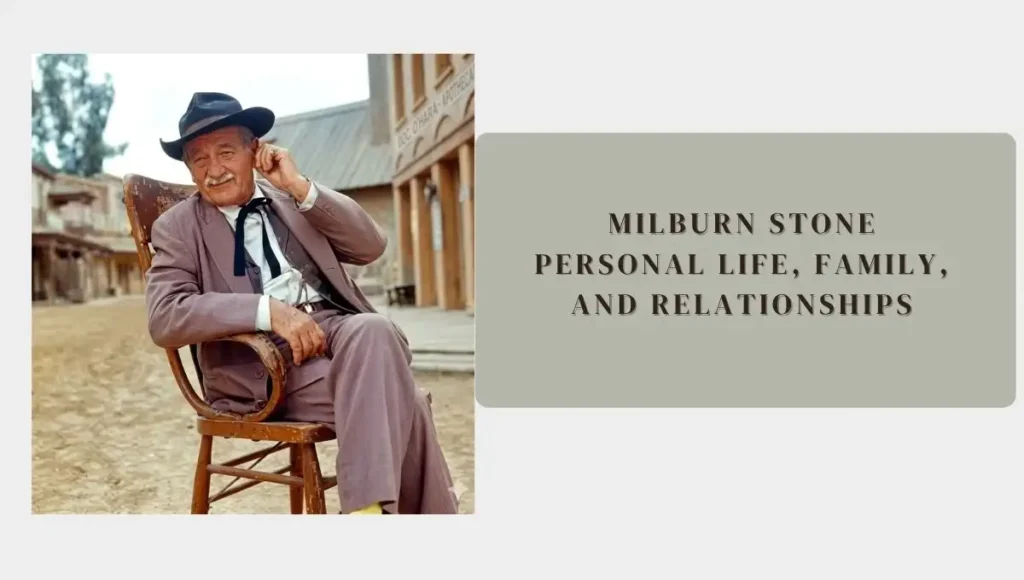
Milburn Stone personal life is partially obscured by his deliberate privacy, and some sources conflict on the details of his marriages. The most consistently cited facts: he was married at least twice, with one marriage lasting until his death. Some sources reference marriages to Nellie Morrison, Jane Garrison, and Betty Jane Acker; the discrepancies may reflect record-keeping variations of the era.
He had at least one daughter, Shirley Stone Gleason, who outlived him and continued his legacy. He and his wife had no other children, according to most accounts, a choice that likely simplified his financial planning.
On set, Stone cultivated some of Hollywood’s most enduring professional friendships. His relationship with James Arness, working together for 20 years, was a genuine brotherhood. He was also close with Ken Curtis (Festus) and was described by Amanda Blake as a mentor and generous colleague. His friendship with Ronald Reagan, then a fellow actor before his ascent to politics, is also documented.
In 1971, Stone suffered a serious heart attack during production, underwent open-heart surgery at the University of Alabama Hospital (reportedly experiencing two clinical deaths during the procedure), and missed seven episodes of Gunsmoke. His return to the show demonstrated the personal commitment that defined his professional life. He died nine years later, in 1980, of another heart attack at age 75.
Legacy and Influence in Hollywood
Milburn Stone legacy is simultaneously artistic and financial. On the artistic side, he helped define what Western television could be, demonstrating that character roles could anchor long-running dramatic series and that a supporting actor’s consistent excellence could become as important to a show’s identity as its lead.
Gunsmoke remains in continuous syndication and streams on services like Peacock and MeTV today. It appeared in Nielsen’s top streaming charts as recently as 2025, seven decades after its premiere, introducing Doc Adams to entirely new generations. Each stream and syndication cycle represents Stone’s enduring cultural presence.
On the financial legacy side, Stone’s estate continues to benefit from the show’s ongoing cultural relevance, even though he sold his residual rights in 1961. His story is often cited as a case study in the value and limitations of lump-sum residual buyouts.
Modern actors negotiating streaming residuals frequently reference the experiences of Golden Age TV actors like Stone as cautionary tales about the importance of protecting long-term income rights.
In 1975, Stone received a star on the Hollywood Walk of Fame. In 1981, he was posthumously inducted into the National Museum of Cowboys and Western Heritage in Oklahoma City. These honors reflect an industry and public that recognized what Stone brought to American television: not flash, not controversy, but two decades of unwavering, craft-driven work that made Dodge City feel real.
Must Read:Craig Monk Net Worth 2026: Cher Lloyd’s Husband Wealth Shocking Real Income Revealed
Frequently Asked Questions
What was Milburn Stone net worth at the time of his death?
Milburn Stone net worth was about $600,000 in 1980, equal to roughly $2.1 million today after inflation adjustment
How much did Milburn Stone earn per episode of Gunsmoke?
Milburn Stone salary grew over time, from around $300–$1,500 weekly in early seasons to an estimated $10,000–$25,000 per episode later.
Did Milburn Stone receive residuals from Gunsmoke reruns?
No, he sold his residual rights to CBS in 1961 for $100,000, giving up future rerun earnings.
How many years was Milburn Stone on Gunsmoke?
Milburn Stone appeared for 20 years (1955–1975) and starred in over 600 episodes, making him one of the longest-running TV actors.
What did Milburn Stone do with his money?
Milburn Stone invested in California real estate, lived modestly, and focused on long-term financial stability rather than luxury spending.
Conclusion
Milburn Stone net worth was approximately $600,000 at death, worth around $2.1 million today is less a story of Hollywood riches than of a character actor who played the long game and won. He spent 40 years grinding through B-movies and supporting roles before landing the role that defined his legacy, then stayed with that role for two full decades with unwavering professionalism.
His financial decisions were mixed in retrospect: selling his residual rights in 1961 meant forfeiting what would have become substantial passive income from one of TV history’s most syndicated shows. But his real estate investments, conservative lifestyle, and steady Gunsmoke salary built a comfortable estate that provided financial security for his family.
What Milburn Stone left behind matters beyond the dollar figures. Gunsmoke is still streaming seven decades after its premiere. Doc Adams is still making audiences laugh and feel, still delivering two-dollar house calls and dispensing frontier wisdom.
That kind of longevity is its own financial legacy, and no amount of residual rights negotiation could have purchased what Stone earned through 20 years of authentic, committed performance.